
- Here’s How Smart Brands Control That Moment -
Imagine walking into a store for milk and leaving with ₹1,200 worth of products you never planned to buy. You blame impulse. But neuroscientists have a very different explanation: you never had conscious control to begin with.
Welcome to the world of neuromarketing – where brands have spent billions studying your brain so they can predict, nudge, and trigger your buying decisions before your rational mind has even woken up.
── PART 1: THE SCIENCE ──
The Subconscious Is Always Shopping
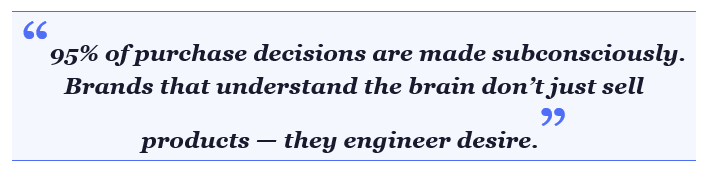
Neuroscientist Antonio Damasio’s landmark research revealed something that upended 200 years of economic theory: humans are not rational decision-makers. We are emotional beings who use rationalization to justify decisions we’ve already made subconsciously.
This is called the “Somatic Marker Hypothesis” — our brains attach emotional tags to experiences and memories, and those tags fire automatically when we encounter related stimuli. That’s why the smell of fresh bread in a supermarket increases total basket spend by up to 30%. Your childhood tagged that smell as comfort, safety, and home.
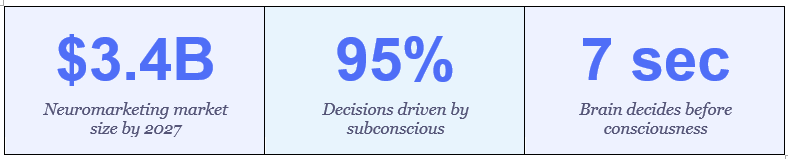
Key Insight: By the time you consciously think “I want that,” your brain made the decision 7–10 seconds earlier in the limbic system.
The limbic system — the brain’s emotional core — processes sensory inputs 200 times faster than the prefrontal cortex (your rational mind). Brands that trigger limbic responses win before the competition even registers.
── PART 2: THE TOOLS ──
How Brands Scan Your Brain
Neuromarketing isn’t metaphorical. It’s a multi-billion dollar science with real laboratories, real scanners, and real data shaping the products on your shelves right now.
▶ fMRI (Functional MRI): Tracks blood flow to different brain regions in real time. Researchers show participants ads, products, or store layouts and watch which areas “light up.” The reward center activating? That’s a purchase signal.
▶ EEG (Electroencephalography): Lightweight headsets that measure brainwave patterns — engagement, frustration, excitement — millisecond by millisecond as subjects watch commercials.
▶ Eye Tracking: Infrared cameras that follow exactly where your eyes move on a webpage, package, or shelf. Amazon has used this to redesign its product page layout multiple times.
▶ Galvanic Skin Response: Measures sweat-gland activity (arousal). The more emotionally charged a stimulus, the more your skin reacts — even when you feel nothing consciously.
▶ Facial Coding: Micro-expression analysis. Brands like Unilever use it to test whether an ad triggers genuine joy vs. polite neutrality.
These tools reveal what surveys never can: what consumers truly feel, not what they think they should say.
── PART 3: REAL BRAND EXAMPLES ──
How Top Brands Exploit Your Brain
Theory is one thing. But the most compelling proof of neuromarketing is in the brands you interact with every single day. Here’s how three of the world’s most valuable companies have turned brain science into billions.
🍎 Apple: The Status Signal
Apple’s legendary minimalism isn’t aesthetic preference — it’s neuroscience. fMRI studies show that viewing Apple products activates the same brain regions associated with religious imagery and spiritual experience. Apple has engineered a tribe identity. When you buy an iPhone, you’re not buying a phone — you’re signaling membership, intelligence, and taste.
The unboxing ritual is calculated: the slow, satisfying lift of the lid activates dopamine release. Every sensory detail is designed to trigger reward before the product is even used.
Neuromarketing Takeaway: Sell identity, not features. The brain buys who it wants to become.
🥤 Coca-Cola: Red Is a Weapon
Red is the single most psychologically stimulating color in the visible spectrum. It increases heart rate, appetite, and urgency. Coca-Cola didn’t choose red by accident in the 1890s — and a century of neuroscience has proven why it works. Studies show that Coke served in a red cup tastes sweeter than the same drink in a white cup. The brain colors perception before taste receptors even report in.
Neuromarketing Takeaway: Color isn’t decoration. It’s instruction. Your packaging is whispering to the limbic system before the customer reads a single word.
📦 Amazon: Remove Every Friction
Amazon’s greatest neuromarketing innovation wasn’t Prime or Alexa — it was the 1-Click Purchase button, introduced in 1997. Every additional step in a checkout process activates the prefrontal cortex (rational mind), which starts asking questions: “Do I need this? Is this a good price? Should I wait?”
1-Click bypasses that entirely. By the time your rational brain assembles a concern, the purchase is confirmed. Amazon held the patent on this neurological shortcut for over 20 years.
Neuromarketing Takeaway: Friction is your enemy. Every extra click, form field, or loading second gives the rational brain time to say no.
── PART 4: THE HIDDEN MANIPULATORS ──
Color, Sound & Smell: Levers You Never See
Every sensory input in a retail or digital environment is a carefully placed lever. Here’s how the world’s best brands pull them:
▶ Color — Red = urgency (clearance sales, fast food). Blue = trust (banks, LinkedIn, hospitals). Green = health and nature (Whole Foods, Starbucks). Yellow = optimism and attention (McDonald’s, IKEA).
▶ Sound — Slow music in stores increases dwell time by 38% and sales by 32% (UK study). Louis Vuitton stores pipe in jazz. McDonald’s plays faster BPM tracks to drive table turnover.
▶ Smell — Singapore Airlines has a patented scent called Stefan Floridian Waters worn by all cabin crew and infused into hot towels. It triggers calm and brand loyalty. Real estate agents bake cookies. Abercrombie douses stores in cologne.
▶ Price Psychology — ₹99 feels fundamentally different from ₹100 because the brain reads left-to-right and anchors on the first digit. Luxury brands do the opposite — ₹10,000 signals exclusivity; ₹9,999 would cheapen it.
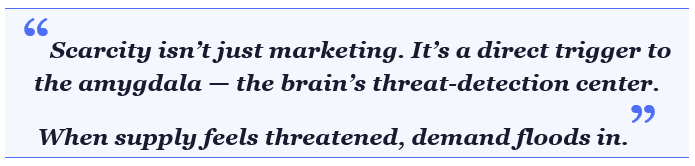
▶ Loss Aversion — Kahneman proved that losing ₹1,000 feels twice as bad as gaining ₹1,000 feels good. “Don’t miss out” and “Only 3 left” trigger loss aversion and are more powerful than any discount.
── PART 5: WHAT THIS MEANS FOR YOU ──
Protect Your Wallet. Influence Your Audience.
Knowing this doesn’t just make you a smarter consumer — it makes you a more powerful marketer, entrepreneur, and communicator. Here’s how to use these principles ethically and effectively:
If You’re a Marketer or Brand:
▶ Lead with emotion, follow with logic. Your headline should activate feeling. Your body copy can justify it.
▶ Design for the lizard brain first. Clean layouts, clear visual hierarchy, and sensory cues reduce cognitive load and increase conversion.
▶ Use social proof strategically. “10,000 people bought this today” triggers herd-following behavior — a survival instinct your brain cannot easily override.
▶ Test everything. A/B test color, copy, layout, and CTA placement. Gut feeling is just your own subconscious. Data is everyone’s subconscious.
If You’re a Consumer:
▶ Wait 24 hours on any purchase over ₹2,000. This allows the prefrontal cortex to re-engage after limbic excitement fades.
▶ Shop with a list and a full stomach. Hunger and openness both lower rational resistance.
▶ Notice the environment. That ambient music, that scent, that warm lighting — they’re not accidental. They’re engineered. Awareness gives you back the wheel.
“The most powerful force in marketing isn’t your ad budget or your reach. It’s your understanding of the 1.4 kg of biology inside your customer’s skull.”
The brands winning your wallet in 2025 aren’t just selling products. They are conducting a symphony in your subconscious – orchestrating emotion, memory, social signal, and desire before you even notice the first note.
Now you know the score.
The question is: are you going to keep dancing, or start conducting?
#Neuromarketing #ConsumerPsychology #BrainScience #Marketing #ImpulseBuying #BrandStrategy


